The first time I taught students to use compatible numbers, I was totally unprepared.  I am guessing that my teachers did the same thing I did.  I read what the book said, followed its examples, and then told the kids to just round.  The next day we recycled their homework and moved on. EEK!

I saw the light after attending a workshop with Greg Tang. It transformed my teaching and how I help my students think about numbers. The goal is to see familiar facts within a given problem and make use of them.

Successfully using compatible numbers requires two things:
1. Make 10 Fact Fluency: Students need to quickly recognize ways to make ten/tens with the numbers in the problem. A few minutes a day investing in practicing these 11 facts makes a huge impact on lots of math skills. Click here to download a poster

2. Ability to Decompose Numbers: Understanding that numbers are flexible and how to apply Addition and Multiplication Properties is essential.  When students do not understand that they can break numbers apart to make them easier to work with, they will not understand how to use compatible numbers to their advantage.

Check this out:


I could add these using a standard algorithm, but students are likely to make simple errors trying to keep track of all of those steps.  It would be a lot easier for me to add 36 + 44 (see the Make 10 fact 6+4?)  How do I make that happen?  By breaking apart my numbers.


By taking away 1 from 45 I am left with two numbers that are easy for me to add in my head. BTW-You could have just as easily taken 1 away from 36 to add 35 + 45. The facts most familiar to the person solving it will be the ones that they see.
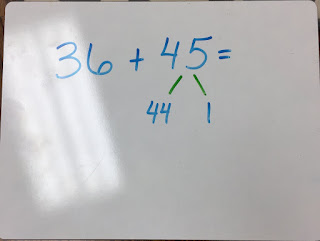

If I want an estimate, this is where I would complete my problem.


If I am looking for an exact answer, I would add the 1 that I took away when making my compatible numbers.


This is very similar to the Near Doubles addition strategy that students learn. They only have to fluently learn a small number of facts, then they are able to use those with strategy to add a large set of facts. Revisit Near Doubles strategies to scaffold using compatible numbers with multi-digit addition and subtraction.


Awesome Resources:
Whack a Number: Addition with Compatible Numbers without Regrouping

Whack a Number: Addition with Compatible Numbers with Regrouping

Whack a Number: Subtraction with Compatible Numbers without Regrouping

Whack a Number: Subtraction with Compatible Numbers with Regrouping

Greg Tang Math Break Apart

Greg Tang Math Printables
Multi-tasking....how do teachers survive without it?  Sometimes I barely feel like I am surviving WITH it!  I'm pretty sure I have trained my brain to require over stimulation.

I know that I am not the only one who has to make sure that everything they do is deeply meaningful and accomplishes multiple goals.  Priorities when developing activities: flexible, assessable, and engaging.

One of my go-to activities is Popcorn Quiz.  It is crazy easy to manage and is flexible enough to use with several different grade levels and skills. I also love that it works if you have 5 minutes or 30.

The combination of those qualities make it perfect for math rotations as skill practice and spiral review.

This is how it all started. While working with my students on make 10 addition facts, I wanted a way to assess them.  Now, I am not capable of giving something as simple as a worksheet that asks them to fill in the missing addends-too boring. I told them we were going to have a pop quiz. Enter Popcorn Quiz.

I put all of the make 10 facts on paper kernels of popcorn, crumpled them up, and put them in a popcorn box.  The kids went around the table answering the question on the popcorn kernel they pulled out of the box.  Instant success!  I didn't have to do anything, but sit back and collect data.


My students began asking when we were going to have another popcorn quiz. Yes, you read that right, they asked for a quiz. So, I started making them for other skills and will continue making more.


Target and Dollar Tree sometimes have plastic popcorn boxes that are super cute. Any box, bag, or bowl will work though. It's fun to print the kernels on white and yellow paper to really bring home the popcorn look.  BTW- I do not waste time cutting out the kernels along the lines. #notimeforthat I just chop them in the paper cutter as rectangles and crumple them up.


If you have an idea for a topic for a popcorn quiz, put it in the comments. Don't forget your email address.  If I make one with that topic, I will send you a copy!

Get a copy free of the Make 10 Popcorn Quiz by clicking here.


Other skills:
Doubles Addition Facts
Compare Fractions with 1/2 Benchmark
Multiply by 5 & 10
Multiply by 2 & 4
Multiply by 3, 6, & 7
Multiply by 8 & 9


The moment I tell someone that I am a math specialist, I hold my breath for a moment and wait for the question to come...."What's up with the way they are teaching math these days?" My heart sinks and I go into marketing mode.

As much as we love to nostalgically look back on our educational experiences, I feel like sometimes we are looking through rose colored glasses.  If the "regular way" worked so well, then why do 95% of people react to my job as if they just smelled rotten eggs? Why do more than 50% of college students require remedial math before they are even able to get credit?

The reality is, I understand why parents are feeling confused!  They are probably seeing kids come home with work using strategies that they were not taught in school.  Unfamiliar things in math tend to panic people. Flashback to the feeling you got the first time you saw a letter in the middle of a math problem. EEK

However, there is no need to panic.  Let's all remain calm and work through a few steps.

Step 1- Find the Examples:  The majority of the time, when parents are most confused by homework, students are failing to bring home their practice books, notes, and not using online resources.

My favorite resources to send home are Khan Academy and  Learnzillion.  These sites feature short videos to review math skills that parents and kids can search for by skill.

Step 2- Use What You Know: Look at the question and use your own problem solving skills.  These strategies are not overly complex, they just may require multiple steps.

These unfamiliar looking steps do not make the problems harder for children.  They teach children something that we were never really taught- how to understand numbers.  Feeble rules are replaced with flexible numbers that are, dare I say, EASIER to work with.

Step 3- Problem Solve: Draw a picture, make a chart, use a number line, try a couple of problems to see if your idea works.

This is what the latest math learning standards are asking kids to do.  THINK! We have spent so many years telling kids to memorize steps above thinking for themselves and then turn around expecting them be capable of problem solving.  It makes no sense really.  When I walk into Home Depot, Mrs. Raye from 4th grade is not there to write out a problem for me to solve, so I can figure out how much paint to buy.
Step 4- Keep an Open Mind: Trust the experts.  Students are learning strategies that are research based and supported by the National Council for Teachers of Mathematics...since the 80's.  These are not new methods. With some patience, the reasoning behind the strategies typically becomes clear by the end of a unit.

More questions?  Post them in the comments below
WARNING: Finding Dory Spoilers in this post...but why haven't you seen it yet anyway???


As I was watching Finding Dory, next to some of my favorite summer school students buddies whom I randomly ran into at the theater, I was suddenly inspired.  I'm not sure exactly what line triggered it for me, but I immediately began making connections to Carol Dweck's Mindset and to many of my students.  Once I started I could not stop.

Marlin: Poor Marlin is the epitome of fixed mindset.  He actively avoids opportunity for growth and does his best to keep his loved ones to follow suit.  New adventures are simply an opportunity to fail. Now, this does not mean that Marlin is bad.  He is doing what he does out of love and a lack of confidence, but if he never leaves the safety of the reef, he will never realize that he is capable of crossing the entire ocean...and more.

Nemo: Nemo is about as growth minded as you can get.  He is ready to take chances and grow from every experience.  He knows that he will make mistakes and need help, but he is willing to take those chances to grow. WWDD? (What would Dory do?)

Jenny & Charlie (Dory's parents): What great parents!  I can only imagine how terrifying it would be for them.  However, they did not give up.  They adjusted their parenting tactics to find out what would help Dory learn the best.  They provided her with visual and musical queues to trigger her memory and provide the needed support to allow her to grow.  These two are great inspiration for educators and administrators.

Dory: Just keep swimming! ....enough said

I honestly could go on and on talking about Hank the octopus and Bailey the beluga and their fixed mindsets, as well as Destiny the whale shark who keeps trying no matter how many times she runs into that stinkin' wall.  I will leave you with this thought.  If we live in a mindset fearing our own failure as well as our students, how are we supposed to reach for the stars? (Sorry...I could not help one more Disney reference.)


This week I attended a two day workshop with Robert Kaplinsky. I. LOVED. IT. Luckily for you, I am a sharer...meaning you will be reading a lot about what I took away from the workshop over the course of multiple posts.

Speaking of professional development, how many times have you been in a workshop, PD session at your district, or even a faculty meeting within your own school and you were too scared to share your thoughts?  This fear sets in when we are asked to share our opinions with others.  It's a panic. What if we say something that others do not agree with, or worse, is actually wrong? Eeek!

"If I say nothing, nothing bad will happen to me." -Kaplinsky

Many of our students feel like this...a lot of the time.  What a catastrophic blow to mathematic discussion and productive struggle! Thankfully I spent some time with a talented group of teachers discussing how to handle it. The goal is for students to think freely and move forward without depending on the direction of other students or adults; intellectual autonomy.


  • Community: In a classroom where students feel safe from judgement and ridicule, they will share more freely and will be able to learn from mistakes rather than shutting down.  Set the standard for mutual respect.  Tell everyone up front that nothing short of respectful behaviors will be tolerated, so everyone feels comfortable sharing in class


  • Respect mistakes yourself: Model for your students how to respectfully address mistakes and misunderstandings.  I tell my students that I learn (currently, not in the past tense) the most from the mistakes I make and that I want them to learn a lot!  We not only respect mistakes, but we embrace them and learn from each other.


  • Value the process: Too often we focus all of our attention on the answer.  Is it right? Is it wrong?  What did you get? We take for granted that if a student finds or is told the correct solution, that they are learning. Focus your questions on their thinking and their problem solving process rather than only asking students for their answer.


  • Encourage talking: Students should be talking more than teachers.  The only way for students to gain intellectual autonomy and feel comfortable sharing ideas is by providing the time and space for that to happen.  I promise, this time will be the best investment in your students' learning you will make!  It is well worth having to extend the lesson for another day to take that time for peer to peer, small group, and whole group discussion. 


For too long math instruction has been almost exclusively direct instruction.  Students haven't been encouraged to share ideas that are different from their textbook or their teacher's.  These subtle changes are the first steps to growing mathematical problem solvers. We would LOVE to hear any other ideas you have in the comments below.  Don't be afraid.  This is a safe place to share.

Umm...isn't this a math blog?  Yes, but I am a woman of many passions, including technology integration.  I put together this presentation for a tech workshop this summer and thought I would share them here as well.  If you have any questions or additional ideas to add to this presentation, please comment below!  I love hearing all of the ways people are integrating technology into their educational settings.

Click here for the slides > Tech for Young Learners

By the way, after looking at the slides you may be wondering....yes, I am a Pokemon trainer/hunter.  Gotta catch 'em all!
They say that the first step is admitting you have a problem.  Hi, my name is Lori, and I have a dollar store problem.  I cannot get out of one without spending at least $40. I've decided to start looking at my not-so-cheap shopping trips as an investment in my classroom and my blog posts.  So to those of you reading this, thanks for feeding my addiction!

On a recent binge, I found these adorable Disney die cuts at my local Dollar Tree.

I had no idea of what exactly I would use them for, but I am obsessed with Disney, Mickey specifically, so I HAD to have them...all of them.  I bought every package of the Mickey ones in the store.  (Did I mention I have a problem?)

I thought it would be fun to write the names of U.S. cities on the back of the Cars die cuts.  I was going to have my students use Google Maps to determine how far away the city is from us, how long it would take to travel there, and how much it would cost to get there.  I also thought that having a high school volunteer write the city names would be a good idea.  I was wrong.  Of course, I only bought ONE package of these die cuts, so I am hoping to get back to buy a new set before another crazy teacher gets there and swoops them up.


However, my Mickey ones turned out much better. I mean, how cute are these? I decided to use these as talking points.  I chose topics that I consistently find students need to review, re-work, and reveal to others.  By asking students to talk about these topics, I left the activity open ended and really flexible.  I can require as much or as little detail as I want, depending on the student, the time of year, or grade level.


These cards are great as a warm-up activity.  One student could be in charge of reading it to the class or students could form groups to collaboratively come up with some talking points.

We all know that every minute counts in our day.  During one of those weird transition times where you only have a few minutes, grab one of these cards for a quick spiral.

I am sure that there are a hundred more ways to use these cute cards...and I have a couple more packages to use up.  Please share your ideas in the comments below!
Back to Top